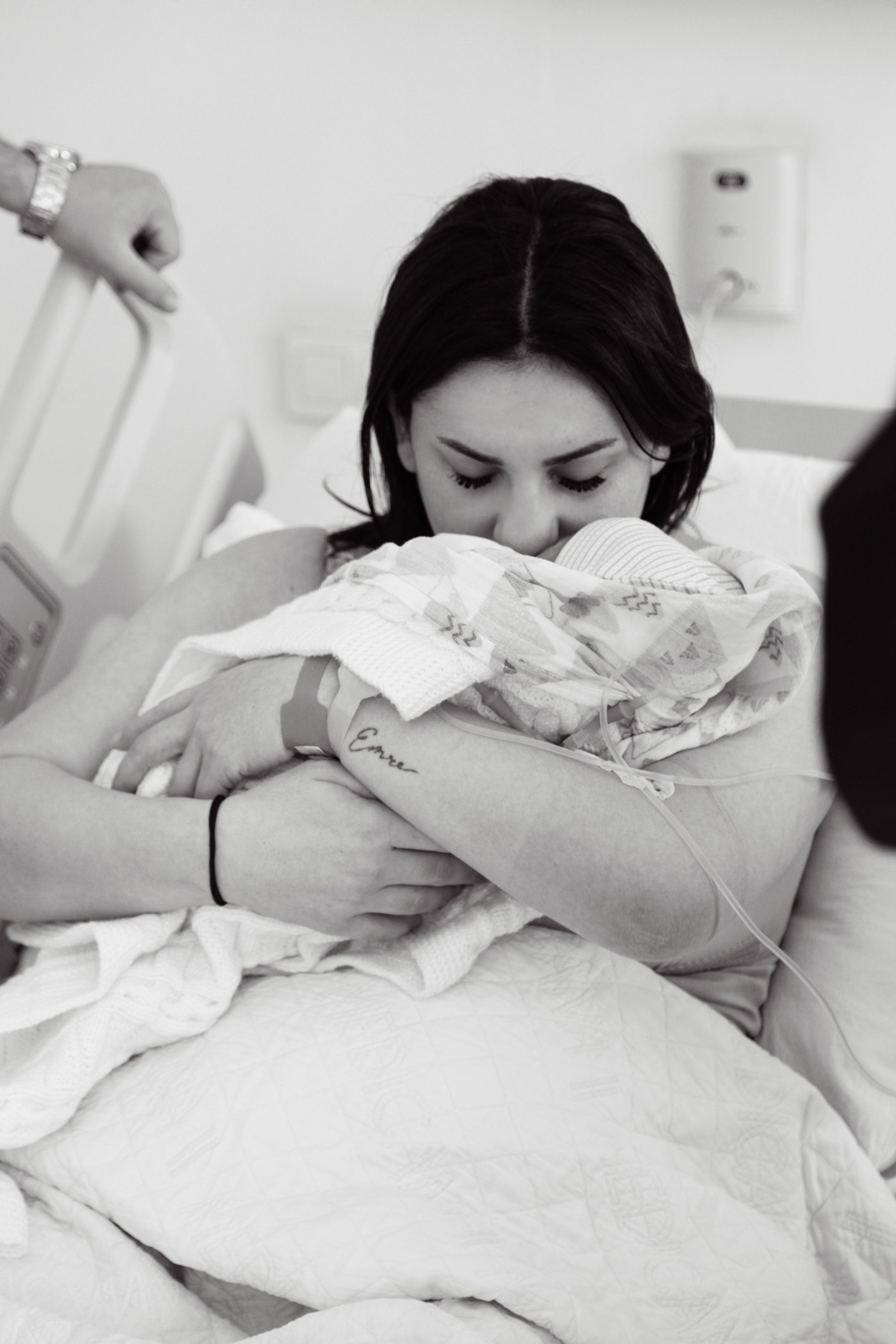
Somewhere around the first birthday, a particular kind of conversational pattern sets in. Every question is about the baby. How's she sleeping. Is he crawling yet. What's the daycare situation. All reasonable, all well-intentioned, and all aimed at a version of the woman that didn't exist eighteen months earlier, while the woman who did exist before motherhood quietly stops getting asked about at all. Identity after motherhood doesn't disappear. It waits. It waits for someone to remember it exists.
The Quiet Disappearing Act
This is not anyone's bad intention. The baby is new and compelling and genuinely needs talking about. The people asking the questions are trying to connect, to show interest, to participate in a phase of life they understand is significant. The pattern is kind in its motivation and quite consistent in its effect: the woman, not just the mother, gradually retreats from the center of conversations that were once organized around her.
It isn't that the woman before the mother vanished. She is, by most accounts, still entirely present, still has opinions about things unrelated to nap schedules, still has a sense of humor that predates the diaper bag, still wants, occasionally, to be asked a question that isn't really about someone else. What changes is how rarely anyone remembers to look for her. The role has become so total, so absorbing and visible, that it has a tendency to consume the entire surface of how other people see the woman in it.
This is not a small thing. Identity, the sense of who you are separate from what you do, or who you care for, needs to be recognized by others in order to stay alive. A self that is never reflected back to you by the people around you is a self that gets harder to access over time, not because it ceased to exist but because there was no mirror for it.
The Internal Version of Erasure
This isn't always external. Plenty of women do it to themselves, quietly retiring the parts of their identity that don't fit neatly into the new role, assuming that's simply what the role requires. The book they haven't read since the third trimester. The hobby that felt frivolous once there was a child who needed the time. The professional ambition that got set aside "for now" and never fully picked back up. The friendships that drifted because there was no longer room in the schedule, and because the conversation that used to feel like home now requires a warmup period and a lot of explaining of context.
The assumption driving much of this internal retreat is that it's necessary, that the role of mother requires the suppression of the self it absorbed. It rarely does. The role requires attention, presence, energy, and sacrifice in genuine amounts. What it does not require is the erasure of the woman doing all of it. That erasure is often offered as the path of least resistance, particularly in a culture that sentimentalizes maternal selflessness, but it is not the same as what good mothering actually demands. A mother who has retained a self is, by most available evidence, a more sustainable version of a mother than one who has surrendered it.
What the Role Does and Doesn't Require
The role requires attention and sacrifice. It does not require erasure, even though erasure is often what gets offered as the path of least resistance. This is a useful distinction, because it changes what recovery looks like. Recovering from genuine exhaustion and genuine sacrifice is one kind of work. Recovering from erasure, from the sense that there is no longer a "you" underneath the role, is a different kind, and it tends to be harder and lonelier, because there is no obvious moment when it happened and no obvious prescription for undoing it.
The path back is almost never dramatic. It does not usually require a sabbatical or a radical life change or the kind of rediscovery narrative that makes a compelling memoir. It tends to be smaller than that: a friend who asks a different question, not "how are the kids" but "what are you thinking about lately?" A half hour reclaimed for something with no caregiving function at all. A conversation in which the topic is not logistics. A return to something she used to love, even briefly, without justifying it to anyone.
The Question That Changes Everything
Finding her again rarely requires a dramatic reinvention. It tends to start with someone asking the right question. Not "how are the kids" or "are you back at work full time" or "what's the plan for the summer," but something that addresses her directly, as herself, as someone whose inner life is assumed to be interesting and worth asking about.
The woman who existed before motherhood isn't a former self to be mourned, or a pre-child version that is now inaccessible. She is still the one doing all of this, the caregiving, the working, the managing, the planning, the holding together. She has more experience now than she did before, and different priorities, and a different relationship to her own capacity. But she is continuous with who she was. She is still in there. She just needs someone to address her directly once in a while, and she needs, sometimes, to be that someone herself.